Subterranean termite soil treatment creates an uninterrupted treated footprint around a structure's primary load-bearing members. Eastern subterranean termites (Reticulitermes flavipes) travel upward from underground…
Subterranean termite soil treatment creates an uninterrupted treated footprint around a structure's primary load-bearing members. Eastern subterranean termites (Reticulitermes flavipes) travel upward from underground colonies through concrete settlement fractures, utility penetrations, and crawlspace piers in Greenville County. Applying a non-repellent termiticide directly into backfill soils alters how subterranean pests encounter the building.
Instead of avoiding a treated strip, foraging worker termites pass directly through the non-detectable formula, cross-contaminating nestmates inside the colony via mutual grooming (trophallaxis).
The mechanical execution requires precise physical integration into local soil geography. In older neighborhoods like North Main, Overbrook, and Alta Vista, heavy Cecil sandy clay loam dominates the root zones.
gov/safepestcontrol/termites-how-identify-and-control-them">EPA termite guidelines to prevent lateral runoff. For homes built on monolithic slabs or partial basements in Gower Estates and Botany Woods, our team drills holes spaced precisely 12 inches apart through interior slab joints, expansion seams, and garage aprons to reach hidden subterranean entry channels. S.
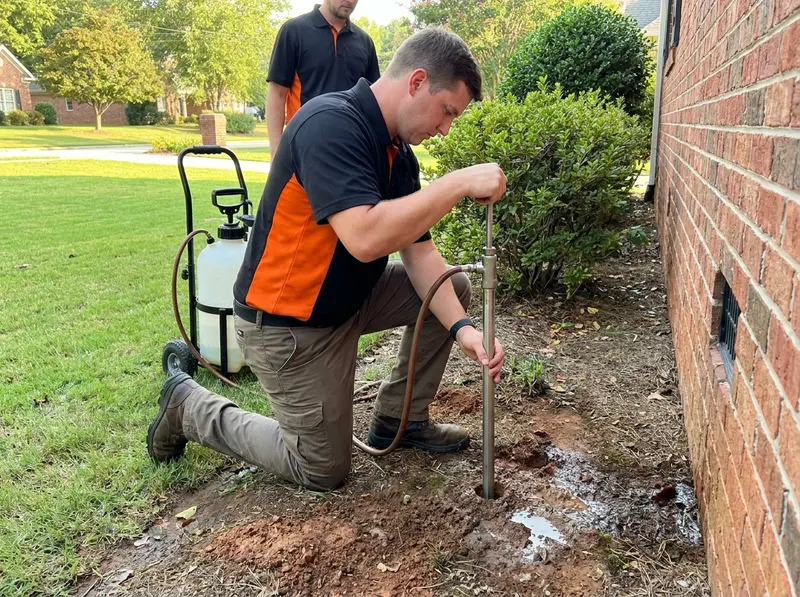
A standard installation follows a clear chronological workflow. Step 1 involves excavating a continuous 6-inch-wide by 6-inch-deep trench immediately adjacent to the foundation wall. Step 2 applies the termiticide emulsion at calibrated volumes directly to the open trench.
Step 3 utilizes specialized steel rodding equipment to inject solution under 25 to 30 PSI down to the footer depth. Step 4 treats the backfill earth before shoveling it into the trench, blending it thoroughly to eliminate untreated voids. Step 5 patches all interior drill access ports with hydraulic expansion cement matching existing substrate colors.
Alternative strategies, such as cellulose bait stations, require termites to locate, consume, and distribute bait matrices over a 60 to 180-day window. In contrast, subterranean soil treatments deliver immediate localized protection by saturating the exact substrate through which workers forage. pdf">USDA Forest Service termiticide field trials.
Every job gets a firm, written price after an on-site visit.
Tell us about your subterranean termite soil treatment job in Greenville and we'll send a clear, written quote, usually the same day.
 IronCove Pest Protection