IronCove Pest ProtectionIronCove Pest Protection

Residential Crawl Space Exclusion Greenville

Older architecture throughout Greenville neighborhoods such as North Main, Augusta Road, Alta Vista, and Overbrook commonly relies on brick pier-and-infill foundations or unencapsulated perimeter footings. Over…
Get My Estimate →(864) 215-5084
Residential Crawl Space Exclusion in Greenville, SC
Quick answer
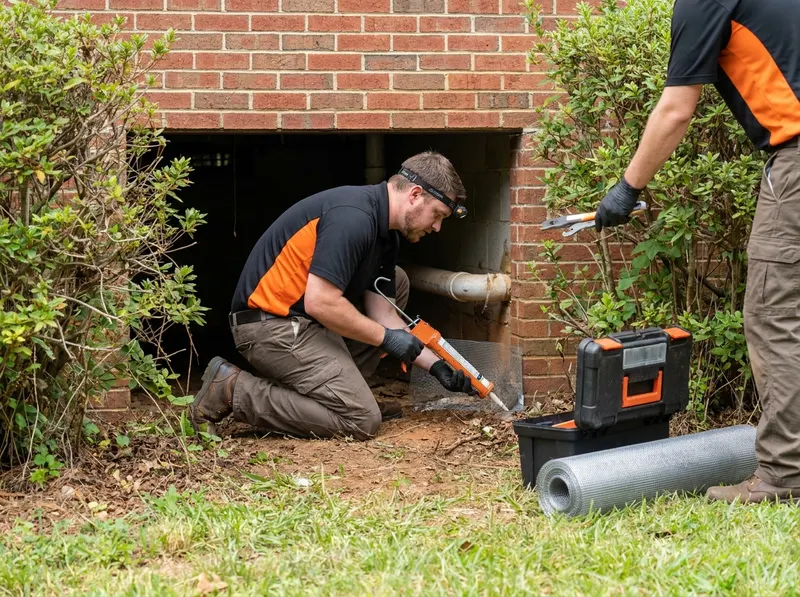
  • What is included: Complete physical barrier sealing including 1/4-inch galvanized hardware mesh on vents, elastomeric masonry sealant on foundation gaps, copper mesh inside plumbing subfloor chasms, and compression-sealed crawl space access doors.
  • Dispatch timeframe: On-site physical diagnostic assessments are scheduled within 24 to 48 hours across Greenville County, with emergency perimeter sealing completed within the same operational window.
  • Standard pricing range: Complete structural exclusion projects range from $650 to $3,200 depending on linear footage and pier counts, with minor single-penetration exclusion repairs starting at a minimum charge of $150.
  • Targeted invasive species: Structural exclusion mechanically stops subterranean termites, Norway rats, roof rats, deer mice, Virginia opossums, eastern gray squirrels, and subterranean German or smokybrown cockroaches.
  • Scheduling process: Review subfloor perimeter conditions, confirm on-site linear measurements, and book service directly by calling (864) 215-5084.

Older architecture throughout Greenville neighborhoods such as North Main, Augusta Road, Alta Vista, and Overbrook commonly relies on brick pier-and-infill foundations or unencapsulated perimeter footings. Over decades, mortar deterioration and plumbing retrofits create unmonitored entry pathways through subfloors and rim joists. The Clemson University Cooperative Extension documents that seasonal temperature drops and high humidity in Upstate South Carolina drive field mice, rats, and wood-boring insects directly into residential crawl spaces. Routine chemical spraying provides only temporary population reduction. Residential crawl space exclusion permanently shifts home defense from chemical reliance to structural engineering. By installing non-corrosive, heavy-gauge materials across every sub-grade aperture, IronCove Pest Protection arrests organism traffic before pests contact living areas.

Subterranean crawl spaces require specialized exclusion materials that withstand elevated soil moisture levels without degrading. Technicians mount 1/4-inch 23-gauge galvanized wire cloth adhering to guidelines from the Centers for Disease Control and Prevention across foundation perimeter vents. This barrier stops rodent gnawing while preserving natural air cross-ventilation calculated under International Code Council residential building standards. Subfloor utility penetrations, including HVAC refrigerant lines, copper pipe sleeves, and electrical conduits running from the crawl space into kitchens and bathrooms, receive dense fills of knitted copper wire mesh backed by closed-cell elastomeric polymers adhering to ASTM International sealant longevity standards. This mechanical setup prevents pests from widening gaps or establishing nesting runs beneath floor insulation.

Crawl space entry doors in communities like Parkins Mill, Gower Estates, and Verdae often consist of standard non-gasketed plywood that warps under humidity, allowing open ingress for eastern gray squirrels, raccoons, and Virginia opossums. The South Carolina Department of Natural Resources identifies crawl spaces as primary urban denning sites for nuisance wildlife. IronCove Pest Protection fabricates heavy-gauge aluminum access frames with marine-grade neoprene weatherstripping, securing access points with dual keyed hasps to eliminate gaps larger than 1/4 inch. For masonry footings around Botany Woods and Dunwoody Oaks, foundation wall expansion joints and hollow concrete block voids are filled with hydraulic mortar and polyurea barrier foams complying with the structural standards outlined by the United States Environmental Protection Agency to prevent thermal loss and subterranean rodent burrowing.

Executing exclusion requires an organized mechanical sequence rather than generic aerosol distribution. Homeowners follow this five-stage process:

  1. Step 1 Baseline Diagnostic: A physical mapping of every foundation pier, band sill, sill plate, subfloor plumbing line, and exterior perimeter vent identifies every breach down to 1/8 inch.
  2. Step 2 Subfloor Preparation: Any torn insulation, fallen ducting, or organic debris obstructing the band sills is cleared to reveal concrete, stone, and wood junctions.
  3. Step 3 Foundation Masonry Sealing: Hydraulic cements and non-shrinking structural caulks seal cracks, cold joints, and gaps where foundation walls interface with brick veneer or wood framing.
  4. Step 4 Mechanical Mesh and Flashing Installation: Technicians mechanically fasten galvanized hardware fabric, heavy-duty aluminum threshold barriers, and copper exclusion mesh over every vent opening and utility penetration.
  5. Step 5 Compression Door Fabrication: Installation of a custom-fit exterior access portal with closed-cell perimeter gaskets locks the entire crawl space envelope against invasive pressure.

Deciding between routine pesticide application and physical crawl space exclusion depends on long-term property maintenance strategies. Chemical treatments require indefinite quarterly re-applications and fail to eliminate pest odor pathways, while physical exclusion requires a single upfront mechanical investment that stops pest ingress completely. The trade-off centers on upfront capital allocation versus ongoing maintenance liability: exclusion demands meticulous physical labor to install permanent metal barriers, eliminating recurring contract dependencies while protecting family members and domestic pets from continuous interior chemical dousing near the Greenville County watershed.

How much does Residential Crawl Space Exclusion cost in Greenville?

Single-Point Minor Exclusion Repair (Starting Minimum)$150 to $300
Foundation Vent Screen Overhaul (10-15 Vents with 1/4" Mesh)$450 to $850
Utility Chase & Subfloor Penetration Sealing (Entire Structure)$600 to $1,200
Custom Compression Crawl Space Access Door Assembly$350 to $750
Comprehensive Subfloor Perimeter Exclusion (Full Structural Envelope)$1,400 to $3,200

Every job gets a firm, written price after an on-site visit.

Common questions

What is the minimum charge for residential crawl space exclusion in Greenville?
The minimum operational charge for residential crawl space exclusion in Greenville is $150, which covers initial localized sealing of single penetrations or minor vent mesh replacements. Comprehensive structural exclusion projects are calculated based on total perimeter linear footage, foundation type, and penetration counts, with exact project pricing confirmed on-site before any mechanical work begins.
How does subfloor exclusion differ from full crawl space encapsulation in Greenville SC?
Subfloor exclusion focuses on physical pest barrier fortification, installing galvanized steel mesh, copper fill, and masonry mortar over entry holes, whereas crawl space encapsulation involves installing a continuous 12 to 20 mil plastic vapor barrier along the earth floor and foundation walls to regulate relative humidity as defined by the U.S. Department of Energy. Exclusion stops biological pest entry; encapsulation controls soil moisture.
Will crawl space vent screens restrict foundation ventilation in Greenville County homes?
No, vent screens installed by IronCove Pest Protection use 23-gauge, 1/4-inch galvanized hardware cloth that complies with Occupational Safety and Health Administration safety parameters and standard residential building codes, maintaining between 70% and 80% free airflow per vent opening while physically stopping rodents, bats, and snakes.
Are chemical rodenticides used inside the crawl space during an exclusion project in Greenville?
Chemical rodenticides are kept to an absolute minimum or eliminated completely during exclusion work, relying instead on mechanical traps and permanent physical barrier materials to ensure rodents cannot die inside inaccessible subfloor cavities. This mechanical approach aligns with pest mitigation guidelines published by the National Pest Management Association.
How long does a full residential crawl space exclusion installation take in Greenville SC?
A standard residential crawl space exclusion installation on an average 1,800 to 2,500 square foot home in Greenville requires between 4 and 8 hours of structural field work. Multi-level historic homes in neighborhoods like Alta Vista with intricate stone or pier footings may require two operational days to complete custom masonry and band sill sealing.

Get started today

Tell us about your residential crawl space exclusion job in Greenville and we'll send a clear, written quote, usually the same day.

Get your pest control services quote, Greenville

We only use your ZIP to check availability, no spam.