Stinging insect populations peak across the Carolina Piedmont between late June and October, driven by the humid conditions near the Reedy River and heavy tree canopies found throughout North Main and Overbrook. Paper…
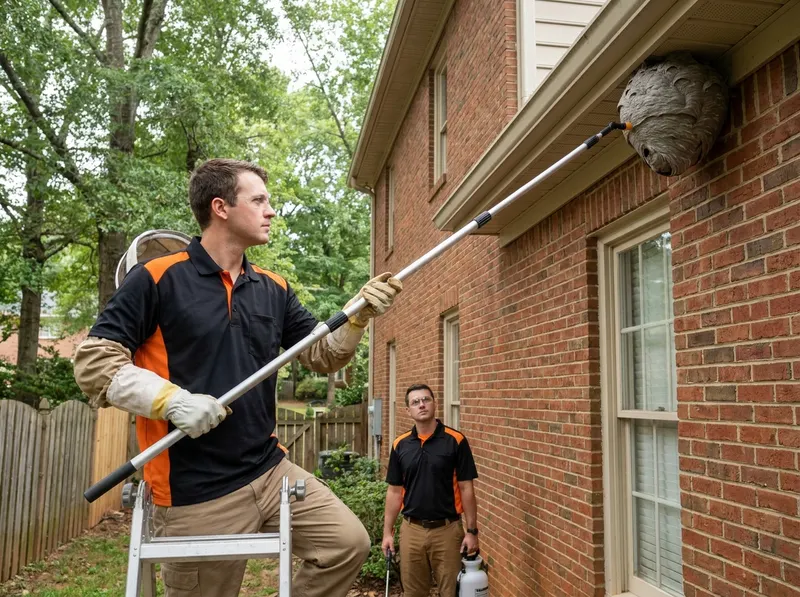
Stinging insect populations peak across the Carolina Piedmont between late June and October, driven by the humid conditions near the Reedy River and heavy tree canopies found throughout North Main and Overbrook. Paper wasps (Polistes dominula) construct exposed hexagonal umbrella nests under soffits and horizontal porch headers, while aerial bald-faced hornets assemble dense, football-shaped paper envelopes high in mature oaks. In contrast, eastern yellow jackets frequently build subterranean colonies within abandoned rodent tunnels or compromise weep holes and brick mortar to colonize wall insulation. Proper identification dictates method: spraying an exterior aerosol into a wall void agitates thousands of workers, driving them inside living spaces, whereas surgical insecticidal dusting and mechanical extraction neutralize the colony at the queen level. Clemson University Cooperative Extension provides specific life-cycle guidance regarding stinging insects in South Carolina that informs targeted non-repellent barrier practices. Our team applies physical extraction followed by perimeter defense rather than repetitive blanket chemical spraying.
Structural colonization presents distinct architectural vulnerabilities across residential communities like Augusta Road and Alta Vista, where historic cedar eaves, stone foundations, and unsealed louvered attic vents invite persistent nesting. In planned developments such as Botany Woods and Gower Estates, secondary void penetrations around HVAC chase pipes, junction boxes, and soffit corners allow stinging insects easy pathways. Treatment protocols adhere directly to EPA pesticide registration standards and strict OSHA safety protocols regarding structural ladder stabilization and full-body personal protective gear. Property owners who manage their properties independently often incur accidental stings by disturbing nests after dark without protective bee suits, risking multiple defensive envenomations. Standard treatments utilize microencapsulated formulations regulated under South Carolina DHEC environmental health guidelines, safeguarding domestic yards while achieving complete colony mortality.
Step 1 involves diagnostic flight path tracing to confirm species and isolate secondary entrance points along wall cavities or ground burrows. Step 2 requires wearing full-suit sting protection to deploy specialized directional pyrethroid or desiccant dust directly into the primary nest aperture. Step 3 encompasses the physical detachment of the brood comb to remove attractant pheromones and developing pupae. Step 4 concludes with structural exclusion, installing copper mesh or silicone sealants over structural voids to prevent sister queens from establishing new colonies in the identical space during the next spring emergence.
Deciding between targeted single-colony extraction and comprehensive perimeter exclusion depends on structural vulnerability. When an isolated nest appears beneath an open deck railing in Parkins Mill or Dunwoody Oaks, simple nest knockdown and residual treatment resolves the threat. However, when yellow jackets penetrate the brick weep line or attic dormers in Verdae or Nicholtown, localized knocking fails; the trade-off requires structural cavity injection followed by permanent mechanical barrier sealing. We maintain deliberate diagnostic control: no unneeded chemical saturation of open turf, and no contractual obligations. Direct communication remains straightforward: Call (864) 215-5084 for immediate evaluation.
Every job gets a firm, written price after an on-site visit.
Tell us about your stinging insect nest removal job in Greenville and we'll send a clear, written quote, usually the same day.
 IronCove Pest Protection